Honouring the legacy of Indigenous Soldiers
Published: November 5, 2025
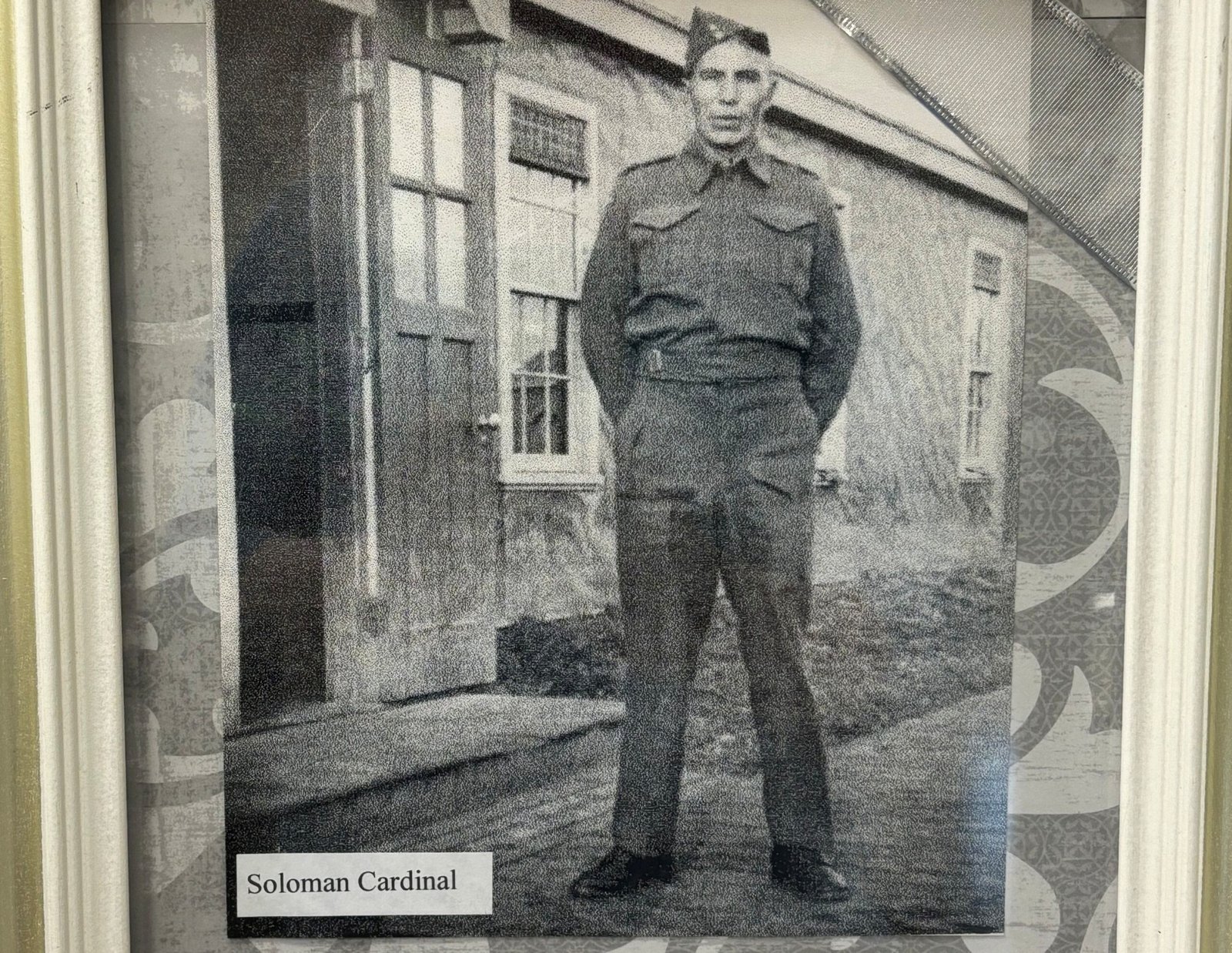
It’s estimated that at least 7,000 Indigenous people served in the First and Second World Wars and the Korean War combined, with many more participating in later military efforts.
Civeo’s Senior Manager of Indigenous Relations, James Norris, shares the story of Soloman Cardinal, his grandfather, a First Nations World War II soldier who never came home.
There’s a framed black and white photo of Soloman Cardinal hanging on the wall at Pakan School, near Good Fish Lake, Alberta. The small tribute from the school Soloman attended nearly 100 years ago is one of very few pictures James Norris has ever seen of his grandfather, whom he – or his father – never got to meet.
Soloman was one of at least 3,000 First Nations members to enlist in the Canadian military in World War II. He would be one of more than 200 Indigenous soldiers to never come home.
James doesn’t know much about his grandfather, only what his family has pieced together from family stories and fragmented war records.
“A section on his enlistment papers asked if he wished to engage in farming when he returned, and he had answered, ‘yes’,” James said. “It could have been an opportunity to build a better life in the future, it could have been a sense of duty, or even just adventure. In the end, all we know is that he left, and didn’t return.”
Soloman was working at a sawmill in Edmonton when he was accepted into the army on July 4, 1942, at age 28. According to enlistment files, he was friendly, athletic, reliable, and “expressed himself very well, despite a heavy accent.” They also note he was one of the most promising “of his type,” suggesting some of the prejudices he and other Indigenous soldiers likely faced.
One year after enlistment, Soloman was assigned to the Canadian Infantry Corps as a rifleman, approved for overseas service, and shipped out to the U.K. to prepare for the Allied forces push to liberate Italy.
As part the Loyal Edmonton Regiment with the 1st Canadian Division, Soloman landed in Italy on Feb. 19, 1944. Allied forces had been battling Axis armies since September 1943, and fighting had been fierce. In May, Soloman was hit by shell shrapnel and admitted to a field hospital. Less than two months later, he returned to his regiment in advance of the Allied assault on the Gothic Line, the last major German defensive line in northern Italy.
On Sept. 18, 1944, Soloman Cardinal was killed in action. Allied forced would push on, eventually taking Rimini and driving Axis forces out of Italy in April 1945.
“To prevent the capture of Rimini, the Germans reinforced the surrounding region, particularly at Coriano Ridge…On September 12, the 1st British and 5th Canadian Armoured Divisions of the Eighth Army resumed the advance on the ridge. The entire corps artillery pounded the enemy front. The next day, after heavy fighting – including house-to-house battles – the Canadians possessed the ridge…battle casualties for the 1st Division in the period August 25-September 22 totalled 2,511, including 626 fatalities.”
– Excerpt from Veterans.gc.ca
His grandfather’s participation in the war left a complicated legacy for James and his family. Under the Indian Act, military service was often tied to enfranchisement, a process that stripped Indigenous people of their legal status and treaty rights in exchange for full Canadian citizenship.
“Our family did lose our status as a result of his service and in many ways, that led to a loss of cultural and community ties,” James said. “There are many people like that, like our family, who grew up ‘in-between,’ not part of one society, not part of the other, which has an immense impact.”
But over his lifetime, James continued to learn more about and embrace who he was and where he came from. It’s part of the reason that he turned to teaching Indigenous awareness in his career, and why Indigenous Veteran’s Day, commemorated each year on November 8, holds such deep meaning for him.

“This day is about recognizing the vital contributions Indigenous peoples made in Canada’s military, understanding the hardships they endured, and acknowledging the lasting impact on their lives, families, and communities,” he said.
Soloman Cardinal rests at Coriano Ridge War Cemetery, southwest of Rimini, Italy, on the western slope of Coriano Ridge. The cemetery contains 1,940 graves, primarily from the U.K., Canada and New Zealand. 427 Canadians are buried here, most of whom gave their lives in the advance to Rimini.
“We pay tribute to the sacrifice he so bravely made.”
A.C. Spencer, Brigadier, Acting Adjutant-General; letter to Soloman Cardinal’s next of kin, Oct. 10, 1944

